Introduction
The moisture content has to be precisely adjusted. The nutrient solution has to be provided to the plants in a predictable manner. Disease has to be minimized, despite the close quarters in which hundreds of plants are housed. Often, soil is not the ideal growing medium and that’s why cocopeat grow bags have turned from a curiosity into an indispensable tool for commercial greenhouse growers in India and beyond.
There were real-world factors that dictated the change, like less control over the moisture levels in traditional beds, challenges in managing diseases and poor yields that could not be overcome with tweaks to the growing regimen.
This article covers everything there is to know about grow bags – their benefits compared to soil, the list of crops best suited for their use, and things to look out for when buying in bulk from cocopeat manufacturers in India.
What Are Cocopeat Grow Bags?
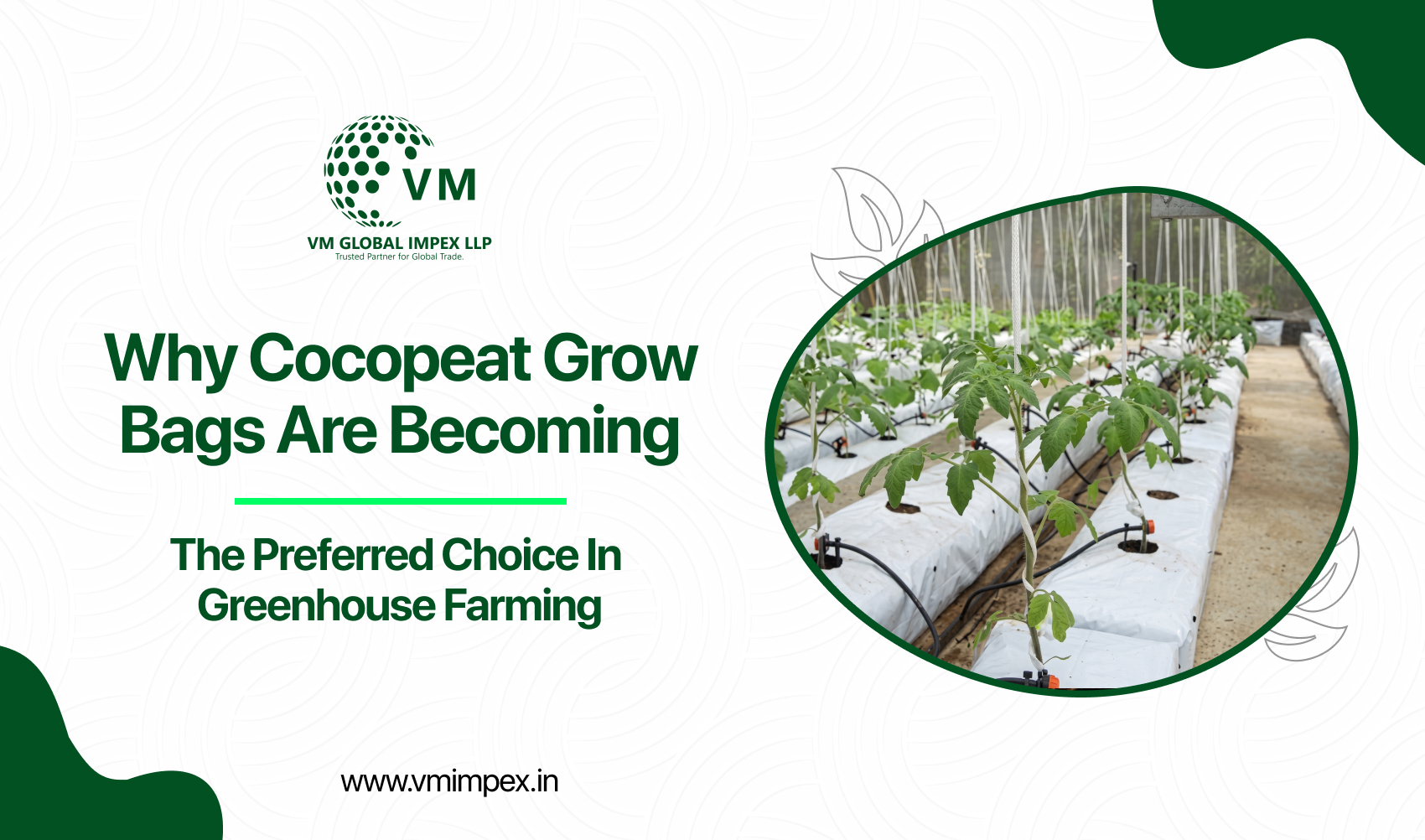
A cocopeat grow bag is a block of processed coco peat, encased in a UV-stabilised plastic sleeve, for use as a growing medium. The bag is designed to be used straight from the wrapper just like simply adding water, and the compressed block of coco peat will expand up to 3 or 4 times its dry size, becoming a light, fibrous consistency that can be planted into almost immediately.
UV stabilisation is more important than you might think for most growers. Grow bags in greenhouses are often exposed to prolonged periods of direct sunlight, and without this stabilisation, the bags would rapidly degrade. A bag that is UV stabilised will retain its structural integrity throughout the crop cycle, and can last up to two or three cycles in some cases.
Grow bags are used in commercial horticulture for producing tomatoes, capsicum, cucumbers, strawberries, blueberries and an increasing number of specialty crops such as cut-flowers. Compared to the use of loose cocopeat, the use of grow bags allows a much more accurate calculation of irrigation and fertilisation requirements for a greenhouse block.
Key Benefits of Cocopeat Grow Bags
Better Water Retention
Unlike sand, which holds on to water on the outside of the sand particles, Coco peat fibre holds the water in the core of the fibres. This allows cocopeat grow bags to hold water for longer periods of time in between irrigation events, while also allowing for good air space to avoid oxygen deprivation at the roots. A grower growing cucumbers using a drip irrigation method which waters the plants twice a day, will often find that the water hold capacity of his soil bag is nowhere near enough.
Excellent Aeration
The root systems of plants require oxygen in exactly the same way that human lungs do. While healthy root systems can tolerate a lack of oxygen for short periods of time, long term oxygen deprivation leads to stunted growth. Coco peat fibre’s natural openness prevents such issues, while also providing a breathable environment for the roots.
Uniform Root Development
The root structure of young plants grown in coco peat are often more uniform than those grown in the field. Because different root structures compete with each other for oxygen and nutrients, one finding among nursery growers when comparing rootballs of plants of the same size grown in field soil vs those in coco peat is that plants with roots in coco peat have denser, more uniform roots. Roots are not fighting against each other for resources and therefore put out a denser, more uniform root structure.
Reduced Soil-Borne Diseases
Since plants are not grown in the field soil, all the pathogens that could make their life miserable, such as Fusarium or Pythium, have significantly reduced chances to penetrate the plant’s root system. This factor alone has become one of the most critical benefits of commercial greenhouse farming using grow bags, as one soil-borne issue can drain the whole season’s profit.
Cleaner Growing Environment
Working in a greenhouse with peat soil can be associated with several inconveniences, such as wet and dirty walkways and the constant need to remove the dirt from the surface. Using cocopeat grow bags significantly reduces the risk of getting soil outside the grower’s bag, thus eliminating the necessity to clean the walkways.
Easier Irrigation
Cocopeat bags are typically used in combination with a drip irrigation system, which is entirely logical, as the consistency of the growing medium in the bags allows for a predictable and reliable fertilizer dosing schedule. Having a uniform substrate eliminates the need to adjust the dose because of varying consistencies of different bags.
Consistent Quality of Crops
Even moisture and nutrient delivery promote even plant growth. A capsicum grower supplying peppers to a retail chain, which sorts them according to size and shape, may find that coco peat helps him to standardize his crops in respect to these features, which is decisive in his decision-making process.
Crops That Perform Best in Cocopeat Grow Bags
Not all crops require a soilless medium, but several have shown to respond very well to it:
- Tomato – one of the most widely cultivated crops in the world in cocopeat bags in greenhouses
- Capsicum – coco peat’s ability to retain water reduces the risk of disease, while its high air porosity promotes rapid root development
- Cucumber – develops long and healthy roots when cultivated in cocopeat grow bags due to the high level of aeration
- Strawberry – a crop that is ideally suited for grow bag cultivation, allowing for easier picking of the fruit
- Blueberry – grows well in coco peat, which typically has a slightly acidic pH
- Cut flowers – gerbera, rose, and carnation growers turn to grow bags to ensure uniformity in flower stems
Why Export Growers Prefer Cocopeat Grow Bags
Growers producing plants for export have specific reasons for opting for coco peat over soil, which go beyond the benefits for the vegetation itself.
A cocopeat grow bag’s characteristics can be controlled to be consistent. It is especially important for the production of plants for export since buyers want reliable characteristics across all their suppliers. Thus, cocopeat grow bags allow travellers to maintain the same expansion ratio, moisture content, and EC level.
They are light, taking significantly less volume than expanded coconut substrate. It is critical to transportation because Indian exporters of coco peat often ship their goods to northern countries, and the travel time is notable. Cocopeat grow bags are light, taking significantly less volume than expanded coconut substrate. This way, producers can save on transportation costs.
The blocks of coconut substrate have predictable expansion rates. Producers of cocopeat grow bags can ensure uniformity in the size of expanded blocks, allowing growers to calculate the required number of bags for a particular crop.
They allow controlling the crop quality to meet the requirements of export buyers. In many ways, it is easier to achieve uniformity when growing crops in coconut bags compared to soil. This factor is vital when selling to foreign buyers since most buyers are looking for a specific grade of products. For example, fruits should have uniform sizes and shapes.
Therefore, bulk buyers of coconut medium tend to prefer trusted cocopeat blocks manufactured in India over unknown ones. It is because only a company with sufficient equipment can provide the necessary quality of the product. Moreover, some buyers set requirements for the level of EC testing and expansion before buying.
Buyer Checklist: Sourcing Quality Cocopeat Grow Bags
Before buying in bulk from any cocopeat suppliers in Tamil Nadu or anywhere else in India, cross-check them with this guide:
- EC and pH reports: Demand laboratory results for each consignment, not just the general specifications for the product.
- Expansion ratio: A rough estimate is that it should be between 5-7 times the original volume when soaked.
- Bag material: The bag should be UV protected – check this for the length of your cultivation cycle.
- Uniformity: If you’re buying in large quantities, ensure there are samples from different production batches. Inexperienced sellers often buy in bulk from one source, not knowing that each bag may have slightly different properties.
- Certifications and export paper: In case of overseas shipping, ensure that all phytosanitary and export documents are in order.
- Price differences: It’s a good idea to request a price quotation for both coco peat grow bags and bricks before choosing a supplier. You may find that different producers offer significantly different rates for washed and buffered coconut coir.
Dealing directly with a cocopeat manufacturer in Tamil Nadu or elsewhere in India may save you from unpleasant surprises due to middlemen’s lack of expertise.
India is among the biggest producers of coconut coir in the world, due in part to the coastal climate of Kerala and Tamil Nadu. Therefore, buyers searching for cocopeat suppliers in India have plenty of options at all price ranges.
From independent coconut bag producers to large-scale manufacturers of cocopeat bricks in India, all kinds of sellers can provide you with coconut fiber for growing. If you’re making a large purchase, narrow your search to the most reputable wholesale coco peat suppliers in India and request samples from each before buying a container.
Common Mistakes Growers Make
- Buying cheapest available cocopeat bricks wholesale tends to be a mistake, because usually, such an option implies that the substrate was not washed and buffered, which often results in inconsistent EC readings after the crop has already started growing.
- Not taking into account the design of bag drainage holes leads to serious problems during the growth of plants with a large number of bags in the system, since localized areas of water saturation are created at the bottom of the bags.
- Failure to rinse the cocopeat before planting leads to salting of the substrate during storage in hot weather, which is especially dangerous for a small crop, but even more so for a full-grown crop.
- Failure to consider the conditions in which bags are stored before use leads to poor quality of the cocopeat, even if the bags are UV stabilized.
Conclusion
Soil-based greenhouse cultivation is a sustainable method with significant variability in terms of moisture, disease, and root development rates that are difficult to manage on a large scale. Cocopeat grow bags eliminate most uncertainties associated with soil-based growing while enabling consistent production of high-quality crops. That is why they are gradually replacing traditional media in commercial greenhouse farming, from small-scale nurseries to large-scale export growers.
When choosing between different growing media, commercial farmers often ask themselves not whether they should adopt grow bags, but rather where to purchase them. VM Global Impex specializes in cocopeat bags for export growers and is ready to manufacture high-quality coconut grow bags according to customer specifications. This way, greenhouse growers obtain a reliable growing medium that requires little maintenance and produces high yields consistently.
Leave a Reply