What is coco peat and why does it matter?
Agriculture changes its shape from time to time. The change of climates, reduced water usage, and shifting to 100% natural farming are not an easy cup of coffee. So, the different types of cocopeat products emerge in crop farming.
From the natural field to the advancement of hydroponics, cocopeat is the best medium. Sensing the key features of extremely lightweight, superb water absorption, renewable bioproduct cocopeat is widely used in agriculture.
Coconut shells are massively used for fiber processing. After the fiber process, the remaining waste, dust-like material, is used for making the coir pith block. As a renewable by-product, multiple types of cocopeat products help agriculture in multiple ways.
They come in the forms of compressed block, bricks, husk chips, grow bags, and coir discs. Finding out the products helps to take your gardening to the next level.
Coco Pith Blocks — How They Are Made and Where They Are Used?
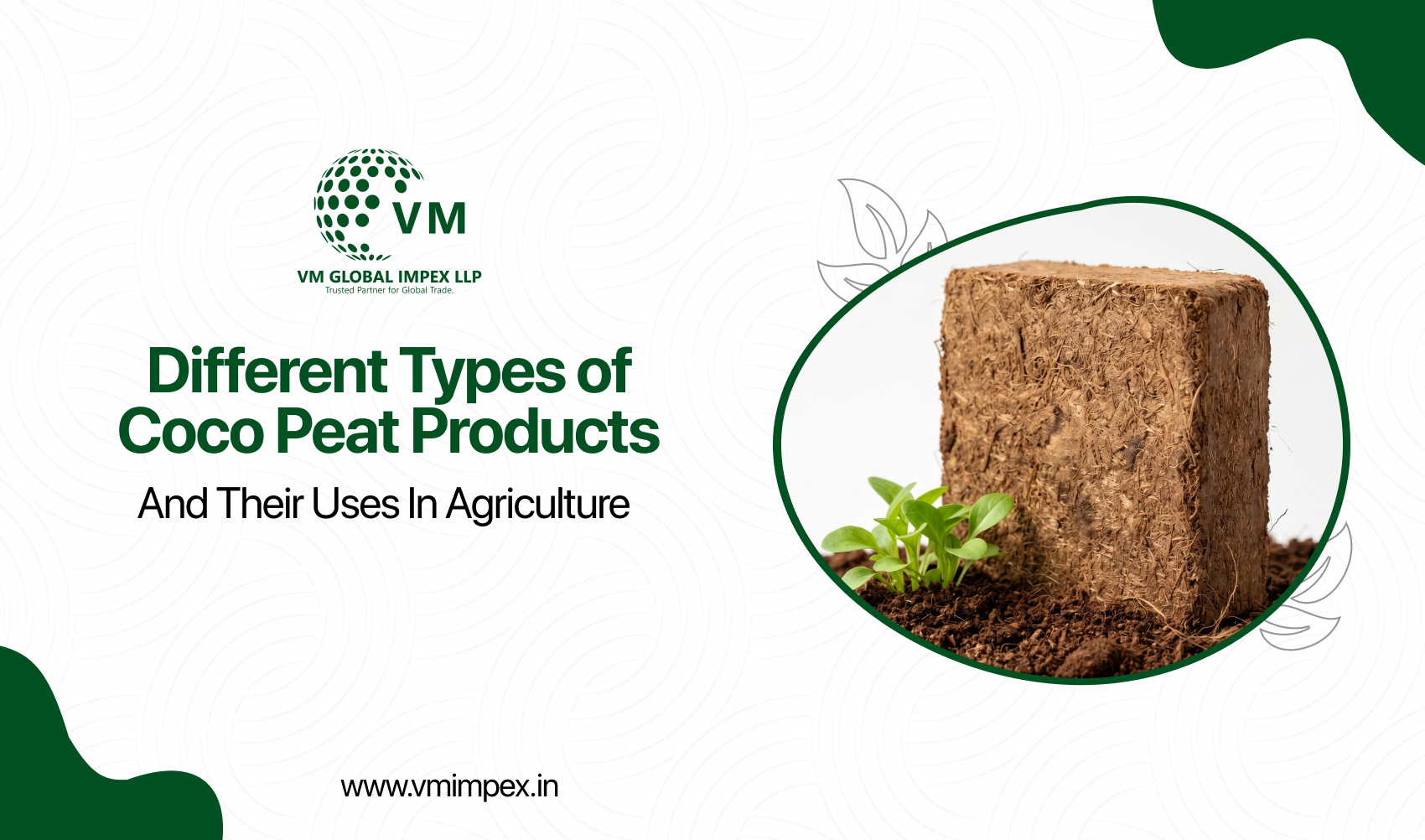
Coco pith blocks are the most common and versatile types of coco peat products used massively in gardening and nurseries. The manufacturing of coir pith block starts with Dried coconut shell. After the removal of raw fiber from the husk, the coir again goes for washing and drying.
This process loses the moisture in it and tight compressing facilitates the bricks. In a dry stage, it weighs from 400 grams to 1 kg. While dipping into the water, it can expand to a size and can hold up to a minimum of 3 to 8 liters of water. For this exceptional quality, and for easy storage purposes, it is widely used in agricultural export.
Coco peat uses in agriculture:
- Soil Modification for Diverse Conditions: Coco peat compressed blocks serve as excellent soil modifiers for sandy and clay soils where water retention and soil structure are poor, opening up new cultivation opportunities greater in compressed cocopeat blocks.
- Versatile for Large-Scale Agriculture: From multiple crop fields and greenhouse farms, achieving the reliability and adaptation of plants via these blocks boosts greater growth.
- Export-Grade Quality for Global Markets: Due to potential gardening competition around the globe, bulk agricultural and horticultural buyers demand the first-grade quality of plant medium. So, the product exporters earn trust through world-class accreditation and export-quality certifications.
What is a cocopeat compressed block? – Use in agricultural fields:
A hard Coco husk is a core material of coco peat blocks, and it is complete dry ready to go for the fibre outtake. The last but waste particles of coir pith manufacturing are known as cocopeat.
For its commercial purpose, easy storage and efficient shipping make the product versatilely used in horticulture and hydroponic applications.
Manufacturing process:
The coconut shell is processed to remove the husk. Then the coconut fibers are processed to reduce its moistures. After the raw coir pith is hydraulically compressed into simple, stackable blocks, typically weighing from 400g to 6 kgs.
Benefits of cocopeat compressed blocks:
Its compact design makes them incredibly efficient to ship and store. In horticulture fields, soil amendment is one of the issues, where these blocks help to keep the soil porous and retain essential moisture.
Free flow of air motivates roots to absorb more oxygen. Simultaneously, the branching out of roots and stem development is more successful in this energy-efficient source.
Nowadays, plant growing has started to be less affected by its soil condition and climate. From heavy forest soils to clays, you can grow plants with this medium.
An electric connectivity level of 0.5 ms/cm is mandatory for a good plant medium. It actively achieves a hydroponic farming system with minimal water usage.
Salt nutrients are excellent boosters of plant growth. The leading cocopeat suppliers fill this nutrient with the core medium of coir compressed blocks, a preferred one in horticulture and hydroponic farms.
What is a Coco coir grow bag, and how is it beneficial for farmers, gardeners, and nursery owners?
Coco coir grow bags are the automatic plant containers that receive the uniform filling under a machine. Your job’s just done, “take it, place it.” Essential processes of hydration and sterilization are all done in these pre-fillers. All these processes ensure convenient air exchange.
Growing plants with an open soil bed face a disturbed, clumsy environment. For addressing these issues in hydroponic fields and greenhouses, coir crow bags are the immediate problem solvers.
Coco coir grows bags come in two different types: one is 100% natural coir pith, and another blend of both coir pith and coconut husk. Both are unique and best as their features.
Features of Coir grow bags:
- Fully made up of natural coir.
- Excessive water retention capacity
- Nature-sustainable medium
- Lightweight & easy for transportation
- Hold more moisture with longevity.
- Encourage uniform growing
Benefits of Coco Coir grow bags:
Choosing the right coir grow bags always saves plants and your gardening efforts. More time consumption is enjoyed over the hectic workshedding of commercial farming units. Besides the offering of practical and measurable results of farming compared to the open soil beds.
- Well growth of Roots
- Reduction of Water Logging
- Prevention of diseases and soil-borne
Easy to integrate with all farming systems. Whether it is a drip irrigation or fertigation system, minimal water usage, proper and complete nutrition delivery is the vital quality that encourages choosing one over another growing medium.
What are Coco Husk Chips?
These are small pieces manufactured from the renewable fibrous outer shell of the coconut, coming in small & irregular shapes. Do these smaller pieces really help in farming?
Yes. If the coir pith blocks offer excellent moisture, texture, and soil retention on plants, the coco husk chips fibrous quality and porous structure allow roots to get free air.
Compared to the other biodegradable medium, its degradation term is very slow. This quality holds the water in a slow but steady release.
The minimal chips are designed in the size of a few millimetres with the blend of husk chips and coir with a 1:3 ratio.
Benefits of Coco Husk Chips:
- The right amount of PH maintenance (5.5-6.5)
- Slower decomposition ensures long-term support.
- As a reusable product, it can be used multiple times.
- For a hot and dry area plantation, it’s a good medium.
Coco Peat Discs & Plugs – Essential for farming
In nurseries, growing tiny seeds and simple cut roots is highly complicated due to their size and peculiar maintenance.
In this phase, coco peat discs & plugs shoulder the responsibility as a good medium to take care of all.
Highlighting features of lightweight, sustainable, and clean media is always an advantage.
It is designed in simple coin-like shapes to place a single seed at a time. For ideal and successful germination, only possible with these coir pith discs.
Manufacturing Process:
Like coir pith, the cocopeat discs are also processed from coconut husk fiber directly. The compression quality is the major difference.
Undoubtedly, it is one of the unique types of cocopeat products. Though it is simple in size, high-pressure compression is required for these coir disc seedlings.
These minimal sizes of the coir discs come in the 30 mm size to protect the future plants from seedlings.
Benefits of Coco Peat Discs:
- A ready-to-use medium for seeds and cut stems.
- Fast water absorption
- Quick dissolvent
- Simple and safe rooting environment
- Free of fiber inhalation
- Tiny, clean, and undisturbed growth platform
How to Choose the Right Types of Coco Peat Products for Your Crop?
However, various types of cocopeats rule the commercial gardening world in immense numbers.
Starting your gardening journey on the right base is vital, but it often ends in a greater dilemma.
In brief, cocopeat blocks play their crucial role in commercial units with their soil amendment and usage of open-soil beds.
In the same way, coir bricks and coir grow bags shrink in size and help home gardens and urban rooftop gardens.
For structural drainage, coco husk chips mean a lot for regulating soil amendments. To begin the plant growth, the coir disc seedling plays its vital role.
Consider all the roles and compare the size, plant & soil category to use these types of products. VM Global Impex LLP: The destination for the right products. Visit us today.
Frequently Asked Questions:
1. Why do farmers use coco peat instead of soil?
Soil is a natural growing environment, but out of weed seeds, fungi, and free of microbial parts. Besides, compactness, water retention, and good aeration are some of the desired reasons for farmers to choose coco peat.
2. Can coco peat reduce water usage in agriculture?
Yes, due to its high water absorption capacity, it helps gardeners reduce irrigation frequency.
3. What is the difference between a coco peat block and a grow bag?
A coco peat block is a compressed form of coir and needs watering, but a grow bag is a ready-for-use medium manufactured as a bag.
4. Which coco peat product is the easiest to transport and store?
Compressed blocks and bricks are small in shape, making them easy to store and transport while using less space.
Leave a Reply